

Positioning
Positioning
Positioning your product correctly can make a significant difference in the success of your marketing campaign. Use these resources to learn how to properly position your product or service.
Planning a Productive and Successful Promotional Campaign
Learn how to plan a productive and successful promotional campaign in just seven easy steps.
7 Steps to Planning a Productive and Successful Promotional Campaign
When planning a promotional campaign keep in mind that a campaign generally consists of three desired outcomes:
Outcome 1: Your promotional message reaches your intended and targeted audience.
Outcome 2: Your message is understood by your audience.
Outcome 3: Your message stimulates the recipients and they take action.
The question is how do you achieve these outcomes with your campaign? The process is easy, but it takes "planning" time.
Here are seven steps that will get your campaign off to the right start.
Step 1: Assess Marketing Communication Opportunities.
It's important in this first step to examine and understand the needs of your target market. Who is your message going out to? Current users, influencers among individuals, decision-makers, groups, or the general public?
Step 2: What Communication Channels Will You Use?
In the first step of planning you should have defined the markets, products, and environments. This information will assist you in deciding which communication channels will be most beneficial. Will you use personal communication channels such as face to face meeting, telephone contact, or perhaps a personal sales presentation? Or will the nonpersonal communication such as newspapers, magazines, or direct mail work better?
Step 3: Determine Your Objectives
Keep in mind that your objectives in a promotional campaign are slightly different from your marketing campaign. Promotional objectives should be stated in terms of long or short-term behaviors by people who have been exposed to your promotional communication. These objectives must be clearly stated, measurable, and appropriate to the phase of market development.
Step 4: Determine Your Promotion Mix
This is where you will need to allocate resources among sales promotion, advertising, publicity, and of course personal selling. Don't skimp on either of these areas. You must create an awareness among your buyers in order for your promotional campaign to succeed. A well rounded promotion will use all these methods in some capacity.
Step 5: Develop Your Promotional Message
This is the time that you will need to sit down with your team and focus on the content, appeal, structure, format, and source of the message. Keep in mind in promotional campaigns appeal and execution always work together.
Step 6: Develop the Promotion Budget
This is the exciting part. You must now determine the total promotion budget. This involves determining cost breakdowns per territory and promotional mix elements. Take some time to break down allocations and determine the affordability, percent of sales, and competitive parity. By breaking down these costs you will get a better idea on gauging the success potential of your campaign.
Step 7: Determine Campaign Effectiveness
After marketing communications are assigned, the promotional plan must be formal defined in a written document. In this document you should include situation analysis, copy platform, timetables for effective integration of promotional elements with elements in your marketing mix. You will also need to determine how you will measure the effectiveness once it is implement. How did the actual performance measure up to planned objectives. You'll need to gather this information by asking your target market whether they recognized or recall specific advertising messages, what they remember about the message, how they felt about the message, and if their attitudes toward the company was affected by the message.
Market Effectively by Solution-Positioning
The key to keeping your marketing efforts effective is to focus on selling the solution to the problem not selling the features or benefits. Find out how companies are benefiting from listening to their target markets pain points.
Our society is bombarded with advertising and marketing messages. How can you make your marketing stand out and be effective to your target market? The answer is easy it’s by taking the time to listen and relating your message to the pain of your client.
Keep in mind that it is easier to sell a solution to a problem than to sell a positive benefit or substantial features. What problems are your potential clients facing? A great way to find out is to spend some time networking and doing market research by contacting potential clients. Find out what their needs are by spending time asking questions and intently listening to their answers taking mental note of their needs, problems, and pain.
Once you see the presence of a problem that your product or service can solve, study that problem and reposition your marketing so that it is offering a benefit and a solution to that problem. You will notice that by doing this marketing and selling will become a lot easier.
Not sure if this works? Take a few moments and consider the products and services that are currently hot on the market. These products include products that help you quit smoking, lose weight, grow hair, and diminish wrinkles. Why are these products reaching a high level of success in sells? The answer is easy; they offer a benefit and a solution to a negative situation or problem.
Once you’ve identified the problem that your product or service solves, it’s time to get to work by drafting your marketing material. When drafting your marketing plan be sure to mention the problem and the solution. This will assist your marketing efforts from going off in the wrong direction. You will want to spend some time researching, problem-spotting, problem-discussing, and solution-positioning.
The key to keeping your marketing efforts effective is to focus on selling the solution to the problem not selling the features or benefits.

Direct Marketing - Part 4 Drip Marketing: Is it Effective?
Drip Marketing: Is it Effective?
Drip Marketing is the method of sending several promotinal pieces to current and potential clients. This method keeps your name in front of your client base. It can be effective but it must be planned and executed successful. Learn how to plan your drip marketing campaign.
What is drip marketing? Drip marketing is a direct marketing strategy that involves sending out several promotional pieces over a period of time to a subset of sales leads.
Is this process effective and how can you begin planning your drip marketing campaign?
The phrase drip marketing comes from the common phrase used in agriculture and gardening called "drip irrigation." This is the process of watering plants or crops using small amounts of water over long periods of time.
It was developed in response to the "Law of 29" in which many marketers believe that an average "prospect" will not turn into a client until they've viewed their marketing message at least 29 times. While I do not necessarily agree with the Law of 29, I do believe in the need to stay in touch with your current and prospective clients in order for them to purchase from you. There are way too many competitors out there, not to.
The method of drip marketing can help you avoid the sell-produce curve. An effective way to use drip marketing is to consistently do something each month to keep your name in front of your current clients and prospective clients. By doing this you diminish the sell-produce curve and will find that you will have a steady amount of business coming in the door.
The best thing about drip marketing is it requires a plan of action. By creating this plan and following it throughout the year you can guarantee that you will be consistent with your marketing all year long. I suggest that you develop your drip marketing campaign when planning your yearly marketing calendar.
It all sounds great, but where do you start? To help you I've listed a plan of action to get you well on your way to developing a productive drip marketing campaign:
- Step 1: Develop your Plan (Plan something EVERY month)
- Step 2: Strategize the Execution of Your Plan
- Step 3: Decide who your Target is.
- Step 4: Create consistency by developing your slogan or phrase. Then place it on every promotional and marketing piece.
What methods can you use for your drip marketing campaign? Here are a few that will get you started:
- Postcards
- Newsletters
- Email Newsletter (You'll have to be careful of spam filters)
- Promotional or Sales Brochures
Think of your drip marketing campaign as a way to nurture your current and potential clients. You campaign should keep them aware of your products and services. With this thought in mind your campaign will succeed.
Direct Marketing -part 3 How to Write Effective Direct Mail Sales Letters
How to Write Effective Direct Mail Sales Letters
This success formula written by guest author Brad Dunn will show you how to write an effective direct mail sales letter that will get a response.
We've all received them. We occasionally read them. However, most end up in the recycle bin . . . But why? They're only a page or two long, and yet many direct mail sales letters are just as dead as the felled log they were fashioned from . . .
Okay, so you've targeted suitable companies, found the name and title of the decision maker for your product or service, and the Trojan-like envelope has made it past the always-suspecting secretary/assistant, and the decision maker has opened up the letter! What will your letter read like? The following checklist will hopefully ensure an image to set yourself apart from the pack.
Ensure the message matches the needs of the target audience.
Does your offer of products and/or services match the needs of the recipient? Don't make your pitch to a company president if your message only applies to the marketing staff.
Get to the point.
If you begin your letter with general, hazy information - you risk losing the reader. It's critical you make your point in those first few lines.
Be clear and concise.
"Brevity is the soul of wit" - William Shakespeare. Right on, Bill!
Sell benefits, not features.
Many businesspersons love to list and discuss product features. However, your potential customers want to know how he/she will benefit from using the product. It's okay to list features, but also include the end-user benefits. For example, a feature of the word processor is that it allows you to write and edit content electronically, so you don't have to retype the entire page. The benefits are that it saves a lot of time, and increases productivity.
Keep it personal and conversational.
Given today's access to current data, there is no excuse for sending out form letters. Personalize each letter you send out in your direct mail campaign. In terms of writing style, just write like you talk - and you're sure to make a warm, genuine appeal to your reader.
Use letters to generate leads - not sales.
The goal of a direct-mail letter is to generate a response, not a sale -whether it be a return mail card, a fax, email, phone call, or fax. The purpose is to open doors - the sale is the next separate and distinct step in the process.
Write at a grade-school level.
Studies have shown that most of us read at an eighth-grade level. Avoid big words to make the letter easily understood. You can be technical if you choose, but simplify your language as much as possible.
Postscript (P.S.) is your friend!
Case studies indicate that the typical letter recipient's eye moves down the page to the P.S. before they read everything in the letter! Try to restate your proposition in the P.S.
Use white space.
Readers are often turned off by large gobs of text. Try to use short paragraphs, and bullets and/or numbered lists. Give the reader some breathing room!
Keep it to one page.
Most presidents, purchasing agents, plant engineers, and other decision makers are very busy people. Make your point, sell the benefits, make it easy to read - and keep it to one page.
Make a "no-risk" offer.
Offer the recipient something - and make it no risk. Offer free information, an article, some industry tips, free tutorial, or product sample.
Create a deadline.
Whether there is a real deadline or one you create, make one. Usually, a deadline increases the rate of responses because of the limited amount of time to act.
Call to action!
Ask and ye shall receive . . . Why not ask for the order? "Call our toll-free number, 800-555-SALES, for a free consultation".
Use postage reply mail.
Include a business reply card for better response. Make sure it has pre-paid postage. Don't lose an inquiry for the cost of a single stamp.
Include a guarantee.
If you can offer a guarantee - be it your follow-up, delivery, customer service, or pricing - do it. By offering a guarantee, you offer integrity and credibility to your products/services.
Include testimonials.
Nothing speaks louder for your product or services than a satisfied end user. However, if you use names and companies, make sure you get a signed authorization from them.
About the Author Brad Dunn is a freelance writer and marketing consultant. He has helped numerous organizations promote themselves and communicate more effectively. After 15 years as a staff writer, he started Vantage Consulting.
Direct Marketing - Part 2 Brochure Marketing : 12 Tips on How to Do it Effectively
Brochure Marketing : 12 Tips on How to Do it Effectively
How can you get the attention of your prospects when using brochures as your direct marketing medium? Julia Hyde shows you not only why you need to use brochures in your marketing plan, but she also shows you how to do it effectively
Marketing isn’t about using one medium. It’s about getting and keeping customers. Yes, Internet marketing can help you can do that but only if you use it in conjunction with other tactical tools. In addition there are thousands of potential customers that are extremely cautious about placing important business or buying an expensive item from an unknown online vendor. That’s one of the reasons why, in order to succeed, EVERY online company must have brochures and other forms of printed sales literature to hand out to customers and prospects. An online company needs printed sales literature for two reasons:
Credibility: People expect a "real" company to have printed sales literature. It's easy to afford spending $60 on business cards, letterhead etc. and call yourself a corporation. But if you want to look like you mean business, you need a brochure of some sort.
Time-saving. People want printed material to take home and read at their leisure. Yes, you can direct them to your Web site, but a brochure adds a personal touch, tells your prospect what the product or service can do for them and why they should buy from you. Brochures also support other advertising, direct mail, online promotions, and can be used as a sales tool by distributors. In short, a good brochure sells.
Here are 12 tips on writing a brochure that will support your online marketing efforts, and increase your sales.
Know What Your Reader Wants
You must write your brochure or leaflet from the reader's point of view. That means the information must unfold in the right order. Begin by analyzing what your reader wants to know. An easy way to do this is by assessing the order in which your reader's questions will flow. For example, imagine you own a medical spa facility offering Botox and other anti-aging treatments. You are interested in encouraging your readers to make an appointment for a consultation and/or schedule a treatment. Now, given the nature of your business, your reader will have a lot of questions they'll want answered before they'll consider making an appointment. Your brochure should answer their questions in a logical sequence following the reader’s train of thought. A good way to organize your points is to write down the questions you think a potential customer might have, and the answers your brochure might supply.
Motivate your reader to look inside
The first page your reader will see is the front cover. Get it wrong and you've as good as lost the sale. Don’t make the common mistake of couching your services in technical jargon. Think benefits or thought-provoking statements that motivate the reader to pick up the brochure and open it. Add a flash that tells the reader there's something inside that will interest them – an exclusive invitation, a free report, special discount or advance notice of sales. Don't be tempted to put only your company logo or product name on the front. It won't work.
Contents Page – What’s in it
In brochures of eight pages or more, a list of contents is useful. Make your list in bold and separate it from the rest of your text. Use the contents to sell the brochure. Don't use mind-numbing words like "Introduction" or "Model No A848DHGT". Pick out your most important sales point and use that in your heading.
Describe Your Product
To help you describe your product draw up a list of product features (facts about your product) and add the words "which means that..." after each point. For example, "The cake is made from an original recipe, which means that...it tastes better." Or, "The car has a 300 horse-power engine, which means that...it goes faster." Remember that the purchaser of your product is not always the user so there may be more than one benefit for each feature.
Make it a Keeper
Putting helpful information in your brochure will encourage the reader to keep it, refer to it often or pass it on to other people. If you're selling paint you can provide hints on color schemes, painting how-to information, tips from the pros etc. If you're selling skin care products you can give your readers tips on how to combat pimples, dry skin, fine lines and wrinkles.
Alter the Shape
Who says a brochure has to be A4? Selling sandwiches? You can design a brochure in the shape of a sandwich. Season tickets to soccer matches? Design it in the shape of a soccer ball. Using your imagination when designing your brochure can produce better than average results. According to Direct Magazine, a recent mailing by CSi, a company that conducts customer satisfaction surveys for automobile insurance firms and repair shops, got a 15% response rate with a brochure delivered in a 32-ounce squeeze sport water bottle. The headline read, “Thirsty for more repair orders?” Try tall and slim, square, oblong. Whatever you like. The only limitation is your imagination, and, of course, your budget.
Make it Personal
An experienced speaker talking to a large audience will pick out a face in the crowd, and talk to that face. This connection with one person allows the speaker to make his talk more personal than if he were merely addressing a mass of faces. In a similar fashion, the words in your brochure should use this technique and zero in on one imaginary single person. Why? Because writing in a direct “I’m-talking-only-to-you” style will increase response.
Add Atmosphere
Don't let your brochure sound aloof. Let your reader share your feelings. There's no reason why a brochure about a wood burning stove has to go into the ins and outs of how the stove works. Tell your reader about rain swept winter evenings and snow-bound afternoons. Let your words show them how warm and snug and they'll be when they purchase one of your stoves.
Get Selling...Fast
Remember, not everyone wants to be educated on every aspect of your product or service. Nor does everyone want to know the manufacturing details of your widget. Don't waste their time telling them about things that don't convey a benefit.
Talk about your reader's needs
Don’t get carried away with your own interests. Talk about your reader, not yourself. Here are the first words in a brochure from a company selling insurance: “Insurance is a complicated business. Our company was formed in 1975 to help our clients deal with the process of finding the right insurance to suit their needs. In the last 20 years we have been selling insurance to a wide range of customers from many different walks of life. Our company's reputation is unsurpassed in the industry...” Yawn...This is the bar room bore in print. Instead of telling you how the company can help solve your problems, it's more interested in telling you about itself.
Give Directions
Every brochure should be organized so the reader can flip through the pages and easily find what they want. Provide clear signposts or headlines throughout the brochure and make sure each one says: “Hey, pay attention to me!”
Ask for Action
Regardless of how you organize your brochure, there's only one way to end it. Ask for action. If you want your reader to respond include an 800 number, reply card, or some form of response mechanism. In fact, to increase your brochure’s selling power you should include your offer and a response mechanism on every page.
Direct Marketing
Direct Marketing
Explore direct marketing such as database marketing, direct mail, mailing list options, and more. These resources will teach you how to be successful in your direct marketing campaign.
Making a Hit with Your Marketing Campaign
How can you get your direct mail stand out from the junk mail and be a success? Guest author Susan Friedman shows you some simple techniques that will help you make a hit with your marketing campaign.
Considered a vital link in a show's promotional plan, direct marketing is vital only if it's done right. It's certainly not as simple as typing a letter, adding an address and stamp, and popping it in the mail. Direct marketing specialist Debbie Bermont, president of San Diego-based Source Communications, offers her golden rules for creating that vital, highly successful direct marketing campaign.
There are some key golden rules to making your direct mailings work effectively. That doesn't mean that you have to spend more money in order to succeed. Far from it. In fact, you could find yourself spending less -- or at least spending more strategically -- than you may be doing at present. Here's how:
Mail to Mr. Right
There's a simple but very clear distinction between junk mail and direct mail. Junk mail is mail that isn't wanted. Direct mail is something that goes to the right person and is wanted. One major key to the success of your direct mailing is to find the right people to mail to. If you are working on a follow-up show, then targeting the people who signed up last year would be a good place to start. If it's a new show or a new list, your first job is to start with a research phone call to find out who that right person is. Even if you're using last year's list, it is still worth a telephone call to check that your information is up to date. Don't ever rely on anyone passing your mailer on -- it just won't happen.
Boost Your Letter
Once you've found out who to send your letter to, your next step is to make sure that your letter works to its maximum effect. Write it as a one-on-one dialogue. Beware of using industry lingo that your prospect may not understand. Keep your paragraphs short and sweet -- no more than seven lines. Break up your letter into clearly defined subheads. And keep it to two pages in length.
Make All Your Copy Benefit-Oriented
List the benefits so they are easy to understand. And remember that a benefit is a lot different than a feature. Features do not have the clout that benefits do. For example, stating that "10,000 people attended our show last year" is merely a feature. Write it in the context of a benefit: "You can have the opportunity of making 10,000 qualified contacts in three days," and you'll start making the impact that you want.
Repeat your offer at least three times throughout your letter: in your headline, within the first two paragraphs, and again in your closing paragraph. You can also include it in a "p.s." Last, but not least, tell your prospects what the next step is and tell them to do it today. Also include details of where to go for more information. Your goal should be for the recipients to immediately respond to your letter in a positive way.
Make an Impact
Your mail piece must stick out from all the rest. Yours will not be the only piece of direct mail that lands on your prospects' desks today. The more you can do to catch their attention, peak their curiosity, and urge them to open the packet, the better.
Advertising
Advertising
What is the difference between advertising and marketing? Knowing the difference and doing your market research can put your company on the path to substantial growth. Find out how advertising can be a successful method of marketing.
Marketing vs. Advertising: What's the Difference?
What is the difference between advertising and marketing? Knowing the difference and doing your market research can put your company on the path to substantial growth. Find out why these two components are not one-in-the same.
You will often find that many people confuse marketing with advertising or vice versa. While both components are important they are very different. Knowing the difference and doing your market research can put your company on the path to substantial growth.
Let's start off by reviewing the formal definitions of each and then I'll go into the explanation of how marketing and advertising differ from one another:
Advertising: The paid, public, non-personal announcement of a persuasive message by an identified sponsor; the non-personal presentation or promotion by a firm of its products to its existing and potential customers.
Marketing: The systematic planning, implementation and control of a mix of business activities intended to bring together buyers and sellers for the mutually advantageous exchange or transfer of products.
After reading both of the definitions it is easy to understand how the difference can be confusing to the point that people think of them as one-in-the same, so lets break it down a bit.
Advertising is a single component of the marketing process. It's the part that involves getting the word out concerning your business, product, or the services you are offering. It involves the process of developing strategies such as ad placement, frequency, etc. Advertising includes the placement of an ad in such mediums as newspapers, direct mail, billboards, television, radio, and of course the Internet. Advertising is the largest expense of most marketing plans, with public relations following in a close second and market research not falling far behind.
The best way to distinguish between advertising and marketing is to think of marketing as a pie, inside that pie you have slices of advertising, market research, media planning, public relations, product pricing, distribution, customer support, sales strategy, and community involvement. Advertising only equals one piece of the pie in the strategy. All of these elements must not only work independently but they also must work together towards the bigger goal. Marketing is a process that takes time and can involve hours of research for a marketing plan to be effective. Think of marketing as everything that an organization does to facilitate an exchange between company and consumer.
You will often find that many people confuse marketing with advertising or vice versa. While both components are important they are very different. Knowing the difference and doing your market research can put your company on the path to substantial growth.
Let's start off by reviewing the formal definitions of each and then I'll go into the explanation of how marketing and advertising differ from one another:
Advertising: The paid, public, non-personal announcement of a persuasive message by an identified sponsor; the non-personal presentation or promotion by a firm of its products to its existing and potential customers.
Marketing: The systematic planning, implementation and control of a mix of business activities intended to bring together buyers and sellers for the mutually advantageous exchange or transfer of products.
After reading both of the definitions it is easy to understand how the difference can be confusing to the point that people think of them as one-in-the same, so lets break it down a bit.
Advertising is a single component of the marketing process. It's the part that involves getting the word out concerning your business, product, or the services you are offering. It involves the process of developing strategies such as ad placement, frequency, etc. Advertising includes the placement of an ad in such mediums as newspapers, direct mail, billboards, television, radio, and of course the Internet. Advertising is the largest expense of most marketing plans, with public relations following in a close second and market research not falling far behind.
The best way to distinguish between advertising and marketing is to think of marketing as a pie, inside that pie you have slices of advertising, market research, media planning, public relations, product pricing, distribution, customer support, sales strategy, and community involvement. Advertising only equals one piece of the pie in the strategy. All of these elements must not only work independently but they also must work together towards the bigger goal. Marketing is a process that takes time and can involve hours of research for a marketing plan to be effective. Think of marketing as everything that an organization does to facilitate an exchange between company and consumer.
Develop an Effective 30 Second Commercial
What is your 30 second commercial? What introduction do you use at networking events, that creates interest and response?
If you are like most people you are shaking your head thinking, "Oh no! Not that 30 second commercial lecture again."
It's true most of hate sitting down to write them, they confuse us, baffle us, and well just seem like the most challenging part of networking. We never feel like it's creative enough or professional enough. We want it to be clever, but intriguing.
If you can GRAB the attention of your prospect at a networking event with your 30 second commercial you've opened the door to begin asking qualifying questions. Within seconds Selling your business gets EASIER. With the right 30 second commercial you no longer have to find a way to introduce your business it just comes natural.
The objective of your 30 second commercial is to have 15 to 30 seconds of information that informs someone with the following information:
- Who are you?
- Who is your company?
- What does your company do?
- How can you help?
- Why your prospect should act now?
Seems easy, yes? Unfortunately it's where we all screw up. Take for example the following commercial:
"Hi my name is Laura Schneider, I am CEO/President of ZealSpin, Inc. We are an Interactive marketing company. We show companies how to integrate their offline and online marketing."
What am I missing here? Does this message get your attention? Does it give my prospect an open ended question to move them to the next level of conversation? No it's missing key components to make it powerful and effective, so let's see how we can improve it.
Name: Hi my name is Laura Schneider
Company: I'm the President of ZealSpin Marketing
What I Do: We help companies increase their revenue and strengthen their brand by integrating their online and offline marketing efforts.
Power Question: Do you market your company in both online and offline venues?
How We Can Help: I think we can help you. We have strategy sessions with all of our clients where we bring together a core team of our people and yours. We analyze your current marketing strategy. We give you at least five integration techniques that you can begin doing today that will increase your revenue.
Why the prospect should act now: Would you like to schedule a strategy session?
As you can see the key is not only giving them great information, but it's also asking the right questions. Go ahead give it a try! Post your 30 second commercial in the marketing forum for free critiques and reviews by marketing professionals.
Get the facts
Why do I need a degree?
However you define success, earning your degree is likely to help you achieve your goals. According to Education Dynamics, 60 percent of Malaysia jobs will require postsecondary education by 2020. You may need more education to excel in your current field or to make a smooth transition into a new field.
Defining your pledge for success at makeithappennow.org will get you started. Take it at your own pace. We will provide expert advice for every step of the journey – from determining your goals to researching options to staying motivated along the way.
There’s no better time – define your success and make it happen now!
However you define success, earning your degree is likely to help you achieve your goals. According to Education Dynamics, 60 percent of Malaysia jobs will require postsecondary education by 2020. You may need more education to excel in your current field or to make a smooth transition into a new field.
- Success is different for everyone. Success to you might mean:
- Spending more time with your family
- Finding a career you are passionate about
- Traveling the world
- Feeling financially secure
- Preparing to move into management and leadership positions
Defining your pledge for success at makeithappennow.org will get you started. Take it at your own pace. We will provide expert advice for every step of the journey – from determining your goals to researching options to staying motivated along the way.
There’s no better time – define your success and make it happen now!
Getting Starte
Even a small step forward is the start of something good. Think about what brought you to this site, and what goals you hope to bring to life. Take the following steps at your own pace, as you are ready:
Brainstorm – By reading articles in our advice section, you will receive valuable information on goal setting. Wake your brain up and imagine the possibilities.
Stay informed – If you are still figuring out your goals, more information can always be helpful. Visit our pledge page to sign up for email alerts. We’ll notify you when we have new content from our expert columnists.
Put your goals in writing – By filling out our pledge form, you will answer questions that further help you solidify your goals. Print out the form and place it somewhere you will see it often. Share your pledge on social networks like Facebook and Twitter, or if you are a more private individual, just with one or two people you trust. By holding yourself accountable, and asking others to help you do so, you are that much closer to your goal.
Keep motivated – Give yourself as much time as you need, but hold yourself to a firm deadline. “I’ll finish it someday” is difficult to complete. Check back at makeithappennow.org for new advice and motivation – we’re here to support you throughout your journey.
YOU make it happen, no one else
Not only is this a key rule in marketing, but I consider this to be amongst the most important lessons in life. NO ONE ELSE can make you successful. It's all up to you. YOU are the "master of your destiny" and responsible for your own success.
Conversely, there's not anyone or anything that will make you a failure. It does no good to blame the economy, your education, or whatever bad breaks you've had in your life. Doing so means taking on a victim's mentality. DON'T EVER DO THIS. I can guarantee you that many thousands of people have succeeded despite having it much worse, so don't make excuses and don't convince yourself that you're somehow a victim.
And the grass isn't any greener on the other side either. You have now (or can acquire) everything you need to be successful. Just remember that it's up to you and nobody else. Then go out and do it.
You Make It Happen
Now, for those who might be thinking, "well, that's easy for you to say, Gery!"…the fact is, I've achieved what most people would say is extraordinary success, but it was not handed to me, not by any stretch. I come from a very small Nebraska town and very humble beginnings. When I started in business I had no business education, no experience, and no money to invest. And it took four long years (the first two moonlighting into the wee hours of the night while holding down a full-time job), before I ever saw a profit. I had no mentors, no great leaders or someone to guide me, nor any wealthy relatives to come to my aid. But I decided I was going to become successful and I did. And I've put in the work every day for nearly 25 years now to stay successful.
So...it's not your leader. It's not someone. It's not the economy. It's not the government. It's not the compensation plan. It's not any of these things or any other obstacles perceived to be in your way. If you want to become successful, you can go around the obstacles, go over, go under, or go right through them. Success is yours if you want it, but ONLY YOU control this. Always remember: "If it's to be, it's up to me."
I don't know what my future holds, but I do know who holds my future."
-Unknown
"I found it easier to get rich than I did to make excuses."
-Jim Rohn
"He that is good at making excuses is seldom good for anything else."
-Benjamin Franklin
"I used to say, 'things cost too much.' Then my teacher straightened me out on that by saying, 'The problem isn't that things cost too much. The problems is that you can't afford it.' That's when I finally understood that the problem wasn't it-–the problem was me!"
-Jim Rohn
"Don't wait for someone else to make your life terrific. That's your job."
-Unknown
Leaders are readers

Everything you need for your better future and success has already been written. Go out and get it...and read it. It's one of the easiest ways to climb the ladder of success.
"Learning is the beginning of wealth. Searching and learning is where the miracle process all begins. The great breakthrough in your life comes when you realize it that you can learn anything you need to learn to accomplish any goal that you set for yourself. This means there are no limits on what you can be, have or do."-Albert Einstein"If you want to be truly successful invest in yourself to get the knowledge you need to find your unique factor. When you find it and focus on it and persevere your success will blossom."-Sidney Madwe
Open your eyes to your potential
Open your eyes to your potential
You may not realize it right now, but inside you you have the potential to become very, very successful. Successful beyond your wildest dreams. So why aren't you? By and large, it's because our schools, governments, teachers, professors, and clergy don't teach you this!

Open your eyes to your potential on the contrary in fact, you've been programmed your whole life to accept mediocrity, to believe that conforming and compromising is the way you go through life and that real success is unachievable except for the "privileged." Of course, people that have become highly successful have learned this is not true at all and they have broken out of these artificial constraints...and so should you!
For me, it was reading the classic book "Think And Grow Rich" by Napoleon Hill at the age of 22 that opened my eyes. I was also greatly impacted by "The Magic Of Thinking Big" by David Schwartz. I still highly recommend these books to anyone who wants to do great things in their life.
You may not realize it right now, but inside you you have the potential to become very, very successful. Successful beyond your wildest dreams. So why aren't you? By and large, it's because our schools, governments, teachers, professors, and clergy don't teach you this!
Open your eyes to your potential on the contrary in fact, you've been programmed your whole life to accept mediocrity, to believe that conforming and compromising is the way you go through life and that real success is unachievable except for the "privileged." Of course, people that have become highly successful have learned this is not true at all and they have broken out of these artificial constraints...and so should you!
For me, it was reading the classic book "Think And Grow Rich" by Napoleon Hill at the age of 22 that opened my eyes. I was also greatly impacted by "The Magic Of Thinking Big" by David Schwartz. I still highly recommend these books to anyone who wants to do great things in their life.
"Formal education will make you a living. Self-education will make you a fortune."
-Jim Rohn
"Unless you change how you are, you will always have what you've got."
-Jim Rohn
"Learn something new. Try something different. Convince yourself that you have no limits."
-Brian Tracy
"The millionaire says to a thousand people, 'I read this book and it started me on the road to wealth.' Guess how many go out and get the book? Very few. Isn't that incredible? Why wouldn't everyone get the book?!"
-Jim Rohn
Set goals...and publish them!
A valid plan for success must include not just goals, but published goals too. set your goals and review your goals. Once you've set your goals, print out the page and keep it on the wall near where you work. i.e. Publish them!

Set goals...and publish them
This may seem silly to you, but psychologically it can be a game-changer. No one knows why exactly, but publishing your goals seems to launch activity in your powerful subconscious mind that seems to literally "pull" you towards the achievement of your goals!
Studies on goal-setting have revealed truly amazing statistics. For example, a study of college students who used goal-setting in college found they eventually landed in the top percentile of all earners!
Setting goals is so easy to do, yet 95% of people never set goals. They just never take the time. And who do you think are the most successful, highest-earning people in the world? The 5% group of course! If you want to be in the 5% group, don't even think about ignoring goal-setting!
"People with goals succeed because they know where they're going."
-Earl Nightingale
"You can't hit a target you cannot see and you cannot see a target you do not have."
-Zig Ziglar
-Zig Ziglar
"Put your goals in writing. If you can't put it on a sheet of paper, you probably can't do what it takes to achieve the goal."
-Unknown
"The achievement of your goal is assured the moment you commit yourself to it."
-Mack R. Douglas
"The establishment of a clear, central purpose or goal in life is the starting point of all success. An average person with average talent, ambition and education, can outstrip the most brilliant genius in our society, if that person has clear, focused goals."
-Brian Tracy
"We all have two choices; We can make a living or we can design a life."
-Jim Rohn
"Take up one idea and act on it. Make that one idea your life. Think of it, dream of it, and live on that idea. Let the brain, muscles, nerves, and every part of your body be full of that idea and leave all other ideas alone. This is the way to success."
-Unknown
Have a plan (a realistic plan)
Have a plan (a realistic plan)
Goals are vital, as Rule #10 makes clear, but you must also have a plan to achieve your goals, and it must be realistic.
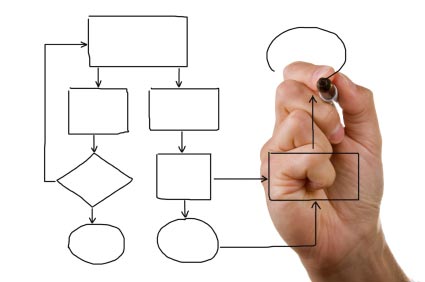
Start with this: Though marketing is truly one of the few businesses where you can earn while you learn, think of your first 6-12 months primarily as a training period. Build this into your plan. In this era of "instant everything," I know that's a tough for a lot of people to deal with, but big incomes simply do not happen overnight. It's just not reality. If it was, everybody would be rich.
Instead, plan to work the hardest your first 6-12 months or so and get compensated the least. Don't expect large earnings until after you've educated yourself and given yourself time to put your plan fully into operation.
Tip: For a great book on creating your plan, try The One Page Business Plan for the Creative Entrepreneur, by Jim Horan
Winning starts with beginning
Winning starts with beginning
There will never be a "perfect" time. Start now, with whatever you have. The tools you need will come to you as you learn more about marketing and work toward your goals. And don't be derailed by "perfection paralysis" either. Realize that you won't be able to do everything perfectly. Do the best job you can. Keep learning and keep moving ahead. That's the key.
"You don't have to be great to get started, but you have to get started to be great."-Les Brown"Everyone who got where he is had to begin where he was."-Richard L. Evans"A determined soul will do more with a rusty monkey wrench than a loafer will accomplish with all the tools in a machine shop."-Robert Hughes"Don't waste time calculating your chances of success and failure. Just fix your aim and begin."-Guan Yin Tzu
Focus
Focus
You cannot become successful in anything when you're trying to do too many things at once. As they say, chase two rabbits and you'll catch neither!

"Most people have no idea of the giant capacity we can immediately command when we focus all of our resources on mastering a single area of our lives."- Anthony Robbins"Nothing can add more power to your life than concentrating all your energies on a limited set of targets."- Nido Qubein"What you choose to focus your mind on is critical because you will become what you think about most of the time."- Noel Peebles"Concentrate all your thoughts upon the work at hand. The sun's rays do not burn until brought to a focus."- Alexander Graham Bell"Success demands singleness of purpose."- Vincent Lombardi"No life ever grows great until it is focused, dedicated, disciplined."- Harry Emerson Fosdick
Send the true information
Send the true information
Send the true information.
Have something positive to share? share it to your group! One of your jobs as an businessman member is to provide your group with motivation, inspiration, and help create and maintain momentum. A super easy way to do this is by regularly using the quality and regular communication with your team
"We increase whatever we praise."
- Charles Fillmore
"Build your people and you will build your business. People will want your approval first and your advice second. Do both. A lot...in that order and you will find that they will like you and willingly follow your suggestions."
- Jack M. Zufelt
"People are eternally divided into two classes, the believer, builder, and praiser...and the unbeliever, destroyer and critic."
- John Ruskin
"There is no investment you can make which will pay you so well as the effort to scatter sunshine and good cheer through your establishment."
- Orison Swett Marden
"We increase whatever we praise."- Charles Fillmore"Build your people and you will build your business. People will want your approval first and your advice second. Do both. A lot...in that order and you will find that they will like you and willingly follow your suggestions."- Jack M. Zufelt"People are eternally divided into two classes, the believer, builder, and praiser...and the unbeliever, destroyer and critic."- John Ruskin"There is no investment you can make which will pay you so well as the effort to scatter sunshine and good cheer through your establishment."- Orison Swett Marden
Don't quit
Don't quit
The only way to fail in business marketing is if you give up.
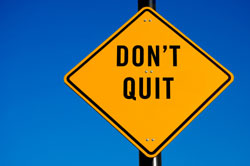 SO many people quit just as they're ready to break through. Imagine mining deep into a mountainside, then walking away mere inches away from striking gold. Don't be that person.
Worse is the person who does this over and over again. If they had just kept digging instead of moving on to the "next great thing" every few months, they'd already have their gold–and they would have reached it so much sooner!
And, yes, sometimes it will seem that your efforts are not accomplishing anything, but always remember that even the mightiest oak tree will eventually be felled by the steady chops of even the smallest axe. Persistence always pays off.
"Other people and things can stop you temporarily. You're the only one who can do it permanently."-Zig Ziglar"Success seems to be connected with action. Successful people keep moving. They make mistakes, but they don't quit."-Conrad Hilton"It's when things get rough and you don't quit that success comes."-Unknown
Think BIG!
Think BIG!
People that do marketing always aim high and dream big! Small desire produces small results, just as a small fire produces little heat.

"Fortune favors the bold but abandons the timid."-Latin Proverb"When you think big, your results are big."-Thomas J. Vilord"The person who goes farthest is generally the one who is willing to do and dare. The sure-thing boat never gets far from shore."-Dale Carnegie"Seize this very minute! Boldness has genius, power, and magic in it."-John Anster
Don't major in minors
Don't major in minors
 Don't let little problems upset you. Concentrate on the positives...and the "big picture."
Also remember that the only thing that will never change is that there will always be changes (especially in today's rapidly evolving world).
Don't let changes upset you. Know that you will have to deal with changes, both big and small, continually. Be prepared to be flexible and to adapt as needed.
"Let others lead small lives, but not you. Let others argue over small things, but not you. Let others cry over small hurts, but not you. Let others leave their future in someone else's hands, but not you. Not you."- Jim Rohn
"We can no more afford to spend major time on minor things than we can to spend minor time on major things."- Jim Rohn
Don't be a negative thinker
Don't be a negative thinker
Your attitude determines your altitude in your life, so make sure it's positive! And don't let the negative attitudes of others (even if they're family members, friends, or peers) influence you. All the great men and women in history had to overcome the naysayers (AKA "Dream Stealers") who said it couldn't be done—and then went out and did it. Think for yourself and believe in yourself!

Have fun and be enthusiastic, too. People love enthusiasm and they can't resist someone having fun. Make your business so much fun that others will flock to you to join you.
"If you believe you can, you probably can. If you believe you won't, you most assuredly won't. Belief is the ignition switch that gets you off the launching pad."-Denis Waitley"Our attitudes control our lives. Attitudes are a secret power working twenty-four hours a day, for good or bad. It is of paramount importance that we know how to harness and control this great force. "-Tom Blandi"Take charge of your attitude. Don't let someone else choose it for you."-Unknown"The greatest discovery of my generation is that human beings can alter their lives by altering their attitudes of mind."-William James"A great attitude does much more than turn on the lights in our worlds; it seems to magically connect us to all sorts of serendipitous opportunities that were somehow absent before the change."-Earl Nightingale"There is real magic in enthusiasm. It spells the difference between mediocrity and accomplishment."-Unknown
4S
Some will, some won't. So what?! Someone's waiting! Next!
 Because most people aren't "entrepreneurial," rejection is natural and normal in our type of business. For every 20 people you present Marketing to, expect 19 "no's" for every "yes." You may do better than that, but expect 19 rejections. This way, the rejections won't bother you. Also, realize that they're not rejecting YOU—they're simply rejecting an idea. Just keep moving ahead.
"Some will, some won't. So what?! Someone's waiting! Next!"
Memorize this and say it to yourself when rejection happens. And remember that you're now one step closer to the next "yes."
Be persistent, ignore the rejections, and you'll get more than enough "yes's" to build a successful business.
"You can experience rejection for free or you can do it for money. Nobody likes rejection but it is a fact of life in just about every thing you do. In business, deal with it or stay poor."-Jack M. Zufelt"Defeat is simply a signal to press onward."-Helen Keller"Every adversity, every failure, every heartache carries with it the seed of an equal or greater benefit."-Napoleon Hill
Persist until you win
Persist until you win
Building a successful business will require persistence and determination. Though many would like you to believe otherwise (including most of our competitors), there's simply no such thing as "get rich quick." And, I'm sorry, but almost all "overnight success" stories you hear about were actually YEARS in the making.

Success comes before work ONLY in the dictionary, but stick with it and you can experience the massive success that those with unrealistic, "I-want-it-now" expectations never hang around long enough to receive.
This is the core of my personal success. I hung around! I'm sure hundreds of thousands of people started a business in 1985 as I did, most perhaps with more experience, more talent, and/or more money to invest, who are no longer in business today. Why did I succeed when they did not? I believe it's because I APPLIED MYSELF to the goals I set for myself and I refused to fail. "Persist until you win" has always been my motto and it continues to serve me every single day!
"Failure is the path of least PERSISTENCE."-Unknown"Nothing in the world can take the place of persistence. Talent will not; nothing is more common than unsuccessful men with talent. Genius will not; unrewarded genius is almost a proverb. Education alone will not; the world is full of educated derelicts. Persistence and determination alone are omnipotent. The slogan 'press on' has solved and always will solve the problems of the human race."-John Calvin Coolidge
Subscribe to:
Comments (Atom)